Albanian myth is not four separate religions sitting side by side. It is one living world of belief, heard in different voices: the house and its rites, the storm that breaks over the fields, the epic songs of the frontier, the fairy tale, and the work-year of sun and fire. The signs on this page are how that world becomes visible. They are not a second gallery of gods.
The two serpents
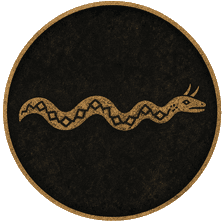
The same serpent power can mean opposite things. In the house, luck has a body: the Vitore (Household Serpent) — fed, never killed. Speak well of it and the household prospers. Kill it and the house falls. In the wild, the Bolla can age toward the storm dragon Kulshedra — drought, springs locked away, a demand for sacrifice. The old ethnographers are clear: the house bollë is one kind of being. The bollë that becomes a kuçedër is another.
House serpent (vitore-sign) — Domestic serpent-sign of household luck and lineage protection, often named vitore or bollë e shtëpisë.
Wild serpent → dragon ladder — Aging path from wild snake (bollë) into the storm dragon (kuçedër/kulshedra) — storm-duel scale, not the house pet.
The dragon and the storm-hero
The duel of Drangue and Kulshedra is one great story, told in three voices. The fight stays the same. The telling changes.
- Weather and ritual. Storm or drought hits the land. Calendar fires and storm saints are called on to right the sky and free the water.
- Epic song. Muji is measured “like a dragua” — a comparison of strength, not a man turning into a dragon. Mountain power rises against a foe from the sea or the plain. Baloz (epic sea-risen foe) remains his own kind of adversary, even when the song shares the same grammar of challenge and victory.
- Fairy tale. A dragon monopolizes the water. A maiden is offered as tribute. A hero frees the spring. Same ecology, told in story voice.
The fight is serpent-force against serpent-force: the drangue carries serpents in the belly as strength. Outside the house, that force ages into drought and chaos. Inside the house, the same substance is luck.
The three fates and the ora
Destiny is written on the third night by three women whose names change by region — Fatia (Fate), Mira (fate fairies), and gentler names used when people prefer not to say the hard word aloud — while luck also has a voice (Ora) and a body (the house serpent). The fate visitors are not ordinary ora, and they are not the mountain Zana (mountain nymph), even when the names trade places.
Third-night fate visit — Birth-night protocol: three fate women visit on the third night and fix the child's destiny.
Ora thread / personal fate-guard — Personal or household ora as guardian of a person's luck and protection — fate-adjacent, not the third-night triad alone.
Sacred number three — Three as the primary ritual/fate number — triad visits, triple acts, triple formulas. 7 / 9 / 40 stay see_also, not separate v1 rows.
Milk and breast-force
Milk moves power across a threshold. It is not only a metaphor. Zana breast-milk gives Muji his strength. Rozafa’s walled breast never stops giving milk. On the wild side, kulshedra’s poisonous milk and the bollar that feeds milk into venom invert the same gift. Nourishment and poison are one circuit, read from opposite sides of the line between house and wild.
Besa — the kept word
Besa is the kept word that can cost a life. Three great stories price it differently. They run side by side. They are not one ballad collapsed into another:
- Wall. Rozafa — the wife built into the castle foundation.
- Grave. Kostandini and Doruntina — the dead brother who rides home to keep a promise.
- Prison. Aga Ymer (Ulcinj besa-return) — the living return from captivity to the house that waited.
Foundation immurement / themele — Building-foundation sacrifice complex — animal/value deposits in themele, remembered as human immurement in castle/bridge ballads (Rozafa).
Threshold / prag (door-sill cult) — House threshold as sacral boundary — ancestor/ora/serpent under the sill, breast-marks of amësi, and the nursing-breast bridge into Rozafa's immurement.
Sacred geography
The land itself has a slope of meaning. Mountain (Father Tomorr, the zana cult, the place where a hero is empowered) descends to the plain (household, band, Kanun law), then to water and sea (foreign danger, Baloz (epic sea-risen foe), bridal crossing, the spring locked by a dragon), then to castle and wall (foundation sacrifice, the besa test, the grave). The paths on the map — hearth and fate, storm duel, castle oath, Muji and the household — are that slope walked.
Tomorr mountain cult — Sacred mountain mark — pilgrimage, oath, and nature-cult residue on Mount Tomorr (with later Bektashi overlay).
Water bride / spring-pool sign — Tirta-native water-bride mark: Ksheta / Nusja e Ujit at springs, pools, and lake banks — combing, whirlpool taboos, silent-bride capture.
Sacred spring / mriz place-mark — Herding rest-groves (mrize) and sacred springs as untouchable nature-cult marks — shade trees not cut, ora/zana rest, healing water.
Sun, fire, and the year
Ritual time is a solar work calendar, wearing Christian and Islamic saint names on the surface. The Sun and The Moon are powers sworn by more than a closed family of gods. Fire drives the year: hinge-fires strengthen the sun. From winter Buzmi (Yule log / midwinter fire) through Summer Day (spring new-year feast), Saint George (spring calendar saint), summer-solstice Saint John (summer solstice fire hinge), storm Saint Elias (thunder / rain saint absorber), and the mountain feast, the year manages weather under one continuous logic. Living fire (Fire (living fire cult), Mother of the Hearth) sits at the hearth. Beside it, Enji (Thursday / fire name) survives mostly as an old Thursday name.
Living fire (friction-fire rite) — Friction-born "living fire" — primitive fire produced by rubbing wood, used to smoke-purify livestock and mark calendar hinge-fires that strengthen the sun.
Spring / calendar fire — Seasonal communal fires (straw, juniper) for fertility and sun-strength — Dita e Verës, Shën Gjergj, and kin feasts.
Buzmi (Yule log) — Ritual log burned at the winter hearth around Christmas / New Year / Kolendra — solar-turn fertility rite.
Hearth mother / vatër fire — Domestic fireplace as cult center — offerings, evening ash rules, personified hearth mother.
Household guard and the evil eye
Beside the house serpent sit the counter-rites that protect gaze and threshold — garlic, soot marks, loom smoke, and the specialist who knows how to break a harmful look. This is not a separate demon with its own biography. It sits next to Shtriga (vampiric witch) and Syqenëz (four-eyed oven hag) as neighboring agents of harm.
Evil eye (harm-turning rites) — Harm-by-gaze belief and the counter-rites / amulets that break or block it.
One living system
Hearth and house serpent keep luck inside. The wild serpent ages into drought. Calendar fire and storm saints manage the weather. Epic and fairy tale narrate the duel. Fate and milk decide who can stand at the threshold. Besa prices the kept word in body and stone. That picture only appears when the domains are read together — which is why signs annotate figures and paths, and why this page links out instead of hosting a separate bestiary of symbols.